
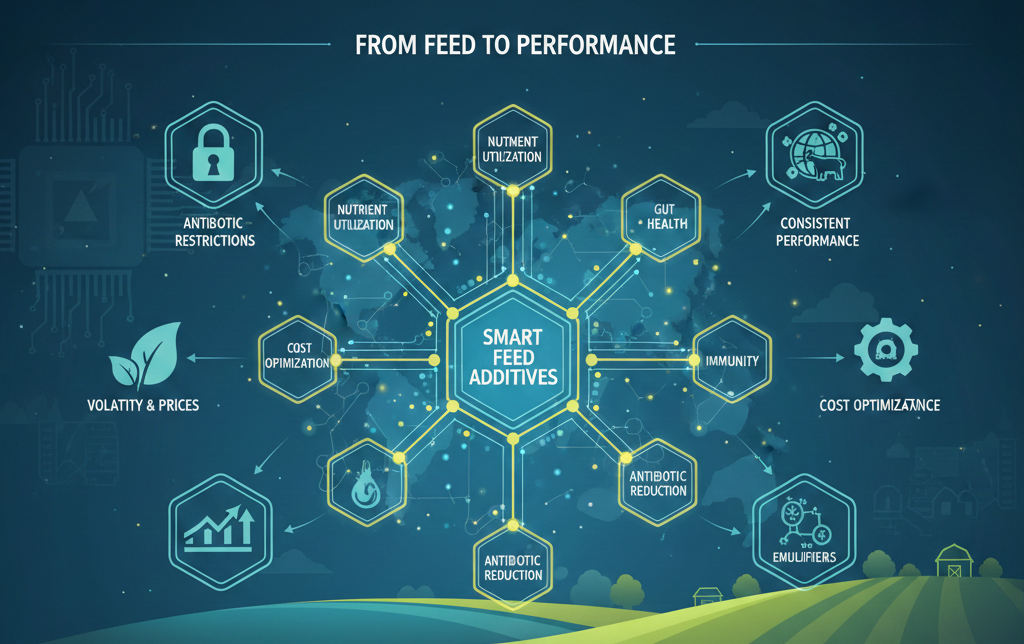
In modern animal production systems, feed is no longer viewed as a simple source of nutrients. It has become a strategic tool to improve animal performance, protect health, optimize costs, and meet increasing sustainability and regulatory expectations. As producers face rising feed prices, pressure to reduce antibiotic use, and growing environmental concerns, smart feed additives have emerged as a key solution to bridge the gap between nutrition and performance.
The Changing Role of Feed in Animal Production
Traditionally, animal diets were formulated to meet basic nutritional requirements for growth and production. Today, the focus has shifted toward precision nutrition, where every component of the diet is expected to deliver measurable benefits. Feed additives—when selected and applied correctly—play a critical role in enhancing nutrient utilization, supporting gut health, strengthening immunity, and reducing production losses.
This shift is driven by several global challenges:
- Increased restrictions on antibiotic use
- Volatility in raw material quality and prices
- Greater emphasis on animal welfare and environmental impact
- Demand for consistent and predictable performance
Smart feed additives address these challenges by working beyond basic nutrition, targeting physiological and metabolic processes that directly influence productivity.
Improving Nutrient Utilization and Feed Efficiency
Feed represents the largest cost in animal production. Therefore, improving feed efficiency is one of the most effective ways to enhance profitability. Enzymes, amino acids, emulsifiers, and organic acids are examples of smart additives that help animals extract more value from the same amount of feed.
- Feed enzymes (such as protease, xylanase, phytase, and amylase) improve the digestibility of proteins, starches, fats, and minerals, while reducing the negative effects of anti-nutritional factors.
- Essential amino acids allow precise formulation, reducing excess protein levels and nitrogen excretion.
- Fat emulsifiers enhance lipid digestion and energy utilization, particularly in young animals or high-energy diets.
The result is a better feed conversion ratio (FCR), faster growth, and lower feed cost per unit of production.
Supporting Gut Health and Immunity
Gut health is now recognized as the foundation of animal performance. A healthy digestive system ensures efficient nutrient absorption, stable intestinal microbiota, and effective immune responses. Smart feed additives contribute to gut health through multiple mechanisms:
- Probiotics, yeast extracts, and β-glucans support microbial balance and stimulate the animal’s natural immune defenses.
- Organic acids and acidifiers help control pathogenic bacteria and improve digestive enzyme activity.
- Nucleotides support intestinal cell renewal and liver recovery, especially during stress or disease challenges.
By strengthening gut integrity and immunity, these additives reduce the incidence of subclinical diseases that silently impair performance and increase production variability.
Reducing Dependence on Antibiotics
One of the most important roles of smart feed additives is their contribution to antibiotic reduction strategies. As preventive antibiotic use declines, nutrition must compensate by enhancing resilience and disease resistance.
While feed additives are not a “quick fix,” their integration into a holistic management approach—alongside biosecurity, vaccination, and good management—helps maintain productivity without relying on routine antibiotic use. This not only supports regulatory compliance but also aligns with consumer expectations for responsible animal production.
Contributing to Sustainability and Environmental Performance
Sustainability is becoming a core performance indicator in animal production. Smart feed additives contribute directly to environmental goals by:
- Improving nutrient efficiency and reducing waste
- Lowering nitrogen and phosphorus excretion
- Reducing the carbon footprint per kilogram of meat, milk, or eggs
More efficient animals require less feed, fewer resources, and produce less environmental output, making nutrition a powerful lever for sustainable production systems.
From Cost to Investment
The perception of feed additives has evolved—from optional cost items to strategic investments. When properly selected, validated by research, and applied at the correct inclusion rate, smart feed additives deliver measurable returns through improved performance, health stability, and reduced losses.
In an industry where margins are increasingly tight, the link between feed, performance, and sustainability has never been stronger. Smart feed additives are no longer just supporting tools—they are essential components of modern, efficient, and responsible animal production.
In conclusion, moving from feed to performance requires more than nutrients alone. It requires intelligent nutritional solutions that optimize biological efficiency while meeting economic and sustainability goals. Smart feed additives provide exactly that connection—turning nutrition into measurable performance.